
The Half-Billion-Dollar Ghost: How a Three-Employee Shell Company Captured America's Nuclear Future
A twenty-year credential machine, $2 million in inaugural donations, and the undisclosed friendship that funneled $507 million from a public company to a WeWork office

The office is on the fifth floor of a WeWork in downtown Washington. Or maybe it’s a Regus, the coworking brand changes depending on which year you check. Three people work there, if “work” is the right word for what happens inside ENTRA1 Energy, a company that describes itself on LinkedIn as a “global energy company” with “11-50 employees” and “decades of experience.”
None of that is true.
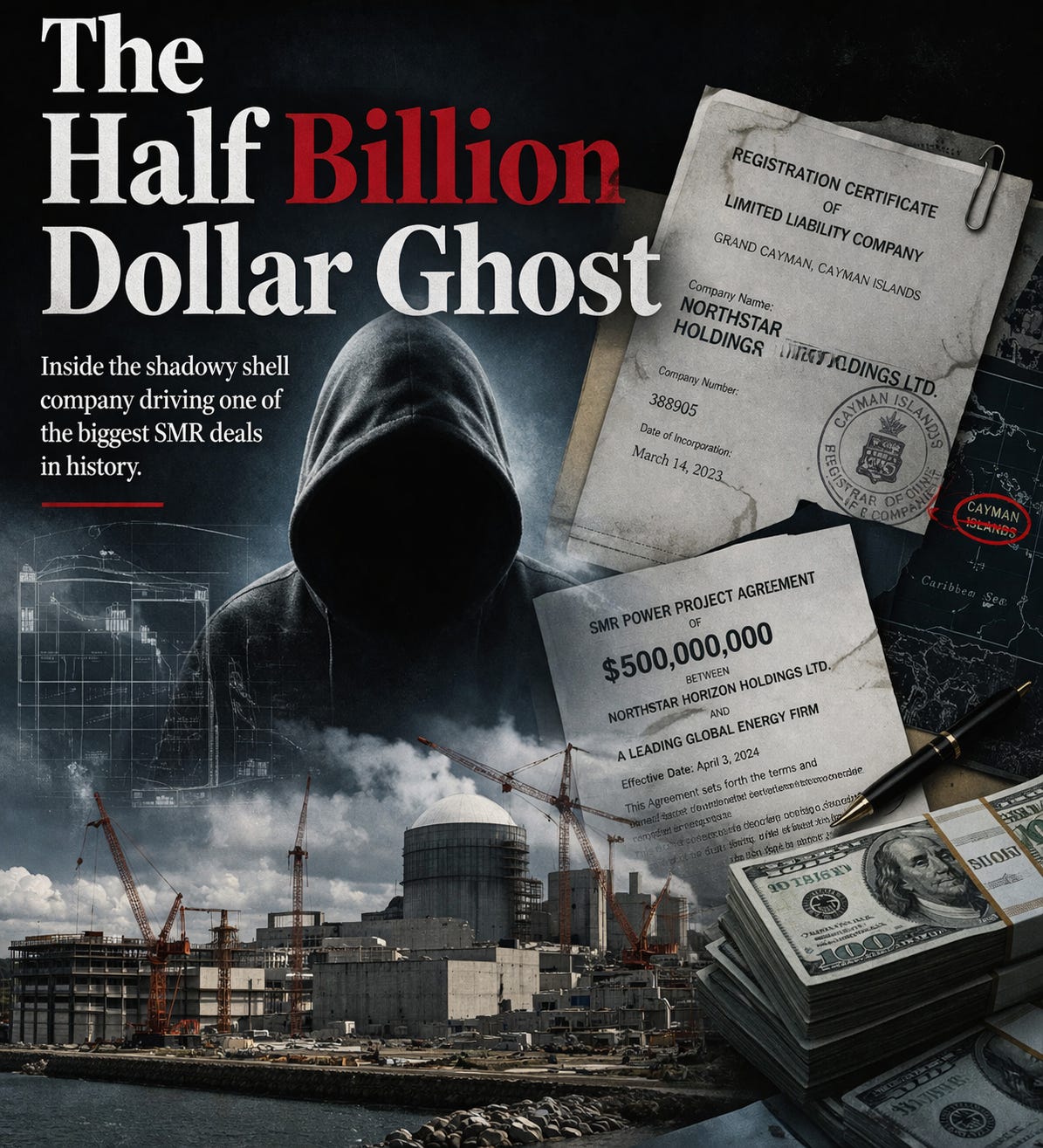
ENTRA1 Energy was incorporated in Delaware on December 23, 2021. It has three employees. It has never built, financed, or operated a single energy project of any kind. It has no power plants, no construction permits, no engineering staff, no procurement contracts. Its “decades of experience” is a reference to the career of its founder’s father, a man whose biographical record before 2003 is, by every available measure, a void.
And yet, by the end of fiscal year 2025, NuScale Power, the only publicly traded small modular reactor company in the United States, ticker symbol SMR on the New York Stock Exchange, had paid ENTRA1 Energy $507.4 million. The payment was sixteen times NuScale’s annual revenue. It represented 83 percent of the company’s total general and administrative expenses for the year.
NuScale received no balance sheet assets in return. The payment was classified not as an investment, not as a capital contribution, but as a general and administrative expense, the accounting category typically reserved for office supplies and software subscriptions.
The CEO who authorized that payment, John L. Hopkins, had known ENTRA1’s founder for approximately a decade. They had worked together at Fluor Corporation, one of the world’s largest engineering and construction firms. Hopkins never disclosed this relationship in any NuScale proxy statement or SEC filing. No special committee reviewed the transaction. No board member recused himself for a conflict of interest. Half a billion dollars flowed from public shareholders to the CEO’s personal associate, and the company’s own disclosures treated it as routine.
This is the story of how that happened, and of what comes next.
---
I. The Credential Machine
To understand the ENTRA1 extraction, you have to understand what came before it. Not weeks before, or months before, but twenty years before. Because the Habboush family didn’t arrive at NuScale’s door with an empty résumé. They arrived with a credential list so impressive it could silence the due diligence instincts of any boardroom in America.
Goldman Sachs. Fluor Corporation. Halliburton. SK Energy. Hanwha Group.
Five names. Five joint ventures. Two decades of cascading access in which each corporate partnership served primarily to credential the next. The service provided at every stage was fundamentally the same: connecting capital to opportunity, providing local knowledge in high-risk emerging markets, and structuring transactions across offshore jurisdictions. What changed was the length and impressiveness of the partner list.
The public face of the operation is Wadie Joseph Habboush, a 44-year-old attorney and energy investor who lives in McLean, Virginia, one of Washington’s wealthiest suburbs and a traditional home to intelligence community professionals. His educational credentials are, on paper, impeccable: a BS in Accountancy from American University’s Kogod School of Business, magna cum laude with Phi Beta Kappa honors, followed by a JD from Georgetown University Law Center. He began his legal career at Kirkland & Ellis LLP, one of the most prestigious corporate law firms on the planet, working in M&A, leveraged buyouts, equity offerings, and fund formation across offices in London, New York, and Washington.
From Kirkland, Wadie moved to Goldman Sachs’ Special Situations Group, where he managed on-balance-sheet energy investments including, most likely, the $2.4 billion Cogentrix portfolio of 26 power plants. He sat on the Cogentrix board. He then spent over fifteen years as an Investment and Operating Partner at I Squared Capital, a legitimate global infrastructure fund managing approximately $50 billion. The credential is verified and real, I Squared is a serious institutional player.
But I Squared has no involvement whatsoever in ENTRA1, NuScale, or the nuclear energy deals that now define Wadie’s public profile. The institutional credibility he accumulated, Kirkland & Ellis, Goldman Sachs, I Squared Capital, provides the surface legitimacy that makes the ENTRA1 arrangement possible. When NuScale’s SEC filings describe their commercialization partner’s “extensive experience,” it is Wadie’s résumé they are implicitly citing. The problem is that the experience belongs to Wadie personally and to the various institutional employers he has left behind, not to ENTRA1, which at the time of the $507 million payment had three employees and had never built, financed, or operated anything.
The Goldman credential opened the door to Fluor Corporation. A joint venture, Fluor-Habboush International Limited, was incorporated in Bermuda on July 4, 2012. The Fluor credential, combined with Goldman, opened the door to Halliburton. The combined list opened the door to SK Energy and Hanwha, South Korean industrial conglomerates seeking local intermediaries for Iraqi mega-projects. And the full accumulated weight of all five partnerships was presented to NuScale Power in 2022 as evidence of a “distinguished track record” justifying exclusive global commercialization rights and $507 million in milestone payments.
Here is the detail that transforms this from an aggressive business story into something more troubling: in every case, the blue-chip partner did the actual work. Fluor won $1.6 billion in Iraq reconstruction contracts directly, through its own subsidiaries, not through Fluor-Habboush International. Hanwha executed the $10.4 billion Bismayah New City project directly. SK Energy pursued its $3.55 billion Basra oil field commitment directly. KBR/Halliburton won its Iraq contracts directly. The Habboush joint venture entity was a parallel asset vehicle, a holding company that provided access, intermediation, and management services alongside the direct operations.
Across all five partnerships, not a single named completed project can be attributed to any Habboush joint venture entity.
This is, to be fair, a legitimate business model in emerging-market infrastructure. Goldman Sachs, Fluor, Halliburton, SK Energy, and Hanwha understood exactly what they were purchasing from Habboush, access and intermediation in high risk, war torn geographies, not execution capability. These were sophisticated institutional counterparties making informed decisions about the services they needed in Iraq, Turkey, and the broader Middle East.
NuScale’s retail shareholders were never given this context. They were told ENTRA1 had a “distinguished track record.” They were not told that the track record consisted of being the access layer in asset-holding vehicles where the actual work was performed by the joint venture partners’ own subsidiaries.
The model became dangerous when it scaled from private institutional counterparties to public market shareholders.
---
II. The Ghost
If Wadie is the public face, his father is a deliberate ghost.
Riadh W. Habboush, known as RW, is the founder and chairman of Habboush Group. He claims forty-plus years of international energy and infrastructure operations. His entities appear in the ICIJ Paradise Papers through the Bermuda law firm Appleby. He donated more than $2 million to Trump inaugurals. His family claims “ancestral roots in Iraq” and “Mesopotamian Judeo-Christian traditions.”
And yet: no discoverable birthday. No nationality. No immigration record. No corporate filing before approximately 2003. No interview history beyond a single 2013 reference. The Wayback Machine contains zero archived snapshots of the Habboush Group website.
Fifteen systematic searches across Iraqi diaspora records, corporate filings, immigration databases, Oil-for-Food Programme documentation, and community archives produced zero pre-2003 biographical data.
Consider what this means. A man who has formed joint ventures with Fluor Corporation, Halliburton, SK Energy, and Hanwha. Whose entities appear in leaked offshore records through Bermuda’s most prominent corporate services firm. Who donated more than $2 million to presidential inaugurals. And for whom the entire publicly accessible biographical record begins, as if from nowhere, in the early 2000s.
This level of opacity does not happen by accident. It requires active maintenance, legal infrastructure, corporate shielding, and a deliberate strategy of biographical erasure. The family’s American legitimacy runs entirely through Wadie’s visible credentials. RW built the structure; Wadie filled it with institutional surface.
The best estimate places RW’s birth between 1945 and 1955, based on his daughter Zena’s birth in February 1974 and his claimed career duration. Zena Riadh Habboush, age 50, lives in Istanbul and serves as Chief of Staff and Director of IT for Habboush Group, confirming that the Turkey connection is family-deep, not merely commercial. A 2025 inaugural donation used a Glen Burnie, Maryland address where no Habboush property or business registration exists, almost certainly a mail drop or nominee address.
The corporate architecture spans at least six jurisdictions and includes more than twenty identified entities. Cayman Islands and UAE holding companies own stakes in Bermuda joint venture vehicles, which are managed through London and New York offices, with project work directed from Istanbul and Dubai. The architecture is typical of sophisticated international infrastructure operations, but it is also highly effective at obscuring beneficial ownership, fund flows, and the ultimate destination of capital.
Three Habboush-related records appear in the ICIJ Paradise Papers, leaked from Appleby: Habboush Group Infrastructure Limited, Fluor-Habboush International Limited, and Wadie Riadh Habboush personally as an Appleby officer. Appleby provides company formation in offshore jurisdictions, trust management and fiduciary services, asset concealment, and tax optimization for high-net-worth individuals. The firm faced Bermuda Monetary Authority regulatory scrutiny in 2015 for anti-money-laundering and anti-financing-of-terrorism deficiencies.
Politico reported in February 2026 that Wadie Habboush has registered ten versions of the ENTRA1 brand with the Delaware Secretary of State’s office. Only two have been publicly identified: ENTRA1 Capital and ENTRA1 NuScale LLC. The remaining eight entity names are behind Politico’s paywall. The proliferation of Delaware entities for what is functionally a three-person operation raises questions about corporate shell management and potential fund-routing structures.
---
III. The Political Activation
Before January 2017, neither Riadh W. Habboush nor Wadie Joseph Habboush had ever made a recorded political donation to any candidate, party, or committee at any level of American government. This fact, confirmed by CREW’s investigation and FEC database searches, is foundational to understanding what followed.
On January 6, 2017, fourteen days before Donald Trump’s inauguration, RW Habboush donated $334,000 to the Republican National Committee. Eight days later, on January 14, he donated $666,000 to the Trump Inaugural Committee. Total: $1 million. The split is significant. The amounts are not round numbers. The two donations went to separate legal entities with separate FEC reporting requirements. The eight-day gap between donations suggests coordinated structuring with awareness of campaign finance mechanics. Someone with FEC expertise, most likely Tommy Hicks Jr., who co-raised millions for the Trump campaign, appears to have advised on the approach.
What that million dollars purchased was not abstract goodwill. It purchased a sequence of escalating access that unfolded with remarkable precision.
Fourteen days after the donation, Wadie attended the Trump inaugural dinner as a personal guest of “DJT”, not a committee guest, not an RNC guest, but a Trump family designee. He was seated next to Reince Priebus, the incoming White House Chief of Staff. Washington Post documents confirm the “DJT” designation, which implies Trump family approval, most likely routed through Donald Trump Jr. via Hicks.
Three weeks after the inauguration, Wadie Habboush and Gentry Beach met with Steve Bannon and National Security Council officials at the White House. The purpose: convince the United States government to lift sanctions against Venezuela. What makes this meeting extraordinary is what preceded it, Wadie had previously met directly with Venezuelan President Nicolás Maduro and Foreign Minister Delcy Rodríguez. He was not merely pitching an idea. He was carrying a message from a foreign head of state to the U.S. National Security Council.
Two weeks after that, at a Palm Beach GOP donor event attended by Trump, Rick Scott, Marco Rubio, and Ronna McDaniel, Habboush introduced Trump to Emrullah Turanli, a Turkish construction magnate aligned with President Erdogan. Turanli, whose company Tasyapi helped develop Trump Towers Istanbul, had been detained in a 2013 Turkish anti-corruption sweep on suspicion of bribery. His company subsequently issued a press release boasting that he was the “first Turkish businessman to meet with Trump.” Facilitating access between a foreign-government-aligned businessman and the U.S. President for purposes of advancing that foreign interest requires FARA registration.
A search of the Department of Justice FARA database returned zero registrations for “Habboush,” “ENTRA1,” or “Habboush Group.”
For comparison: Tom Barrack, the chair of Trump’s inaugural committee who raised $107 million, was charged as an unregistered UAE foreign agent for similar conduct, leveraging inaugural access to advance a foreign government’s commercial and policy interests. He was acquitted in 2022. Imaad Zuberi, a donor who gave $900,000 via Avenue Ventures, pled guilty to FARA violations, campaign finance crimes, and tax evasion. He received twelve years. Rick Gates, deputy to Barrack, pled guilty to conspiracy and making false statements. Sam Patten pled guilty to steering $50,000 in Ukrainian oligarch money into the inaugural.
The Habboush donations, $1 million in 2017, another $1 million in 2025, zero prior political history, extensive foreign business connections, offshore entities in the Paradise Papers, Middle East operations run through Istanbul, fall squarely within the investigated period and profile of the SDNY inaugural probe. The investigation was shuttered in mid-2019 without broadscale donor prosecutions. Habboush was not publicly named. Grand jury materials remain sealed.
---
IV. The Extraction
Phase 5 of the access timeline is where the credential machine converts to cash.
NuScale Power announced a strategic alliance with ENTRA1 in September 2022. The TVA 6GW deal was signed in September 2025, with a TVA board being simultaneously reshaped by Trump appointees. The US-Japan $25 billion framework MOU was signed at an October 2025 Tokyo ceremony where Habboush appeared alongside Trump. Another $1 million donation to the 2025 Trump inaugural had been made.
On September 2, 2025, ENTRA1 Energy signed a non-binding term sheet with the Tennessee Valley Authority for the potential deployment of 6 gigawatts of NuScale small modular reactor capacity across seven states. The agreement was not a power purchase agreement. It was not a binding contract. It was a statement of intent, a letter expressing interest in future negotiations.
That signature triggered a $507.4 million payment from NuScale Power to ENTRA1 under the Partnership Milestone Agreement. Of the $507.4 million recognized as expense, only $148.5 million was actually disbursed in cash during Q3 2025. The remaining approximately $359 million was accrued as a liability on NuScale’s balance sheet, meaning ENTRA1 is owed money that NuScale has not yet sent. The full cash disbursement schedule was not disclosed in SEC filings.
NuScale’s $1 billion at-the-market equity program, announced in March 2026 replacing an earlier $750 million program, appears structured to fund these ongoing obligations, diluting shareholders to pay the CEO’s friend’s company.
The Partnership Milestone Agreement contains provisions that effectively lock NuScale into permanent dependence on ENTRA1. NuScale cannot “directly or indirectly, without ENTRA1’s prior written approval” pursue any opportunity worked on by ENTRA1 or contact any person known to have communication with ENTRA1. NuScale has ceded global commercialization control of its reactor technology to a three-person company owned by its CEO’s personal associate.
This is not a partnership. It is a lockup.
Meanwhile, NuScale’s one real deployment project, the Romania VOYGR, backed by $275 million in G7 funding and a $99 million U.S. EXIM Bank loan, which reached Final Investment Decision in February 2026 — has zero ENTRA1 involvement. The only ENTRA1-associated deals are the TVA agreement (non-binding) and the Standard Power project in Ohio and Pennsylvania (announced October 2023, dead since May 2024). The pattern is: announce, collect milestone, deal dies.
---
V. The Hopkins Connection
This is the structural core of the securities fraud allegations, and the fact pattern that six major plaintiffs’ firms are now circling.
John L. Hopkins has served as CEO and Chairman of NuScale Power since December 2012. Before that, he spent approximately 28 years at Fluor Corporation, rising to Group President of Fluor’s Government Group and then serving as Group Executive until his retirement in March 2013.
On July 4, 2012, while Hopkins was still a senior Fluor executive, Fluor-Habboush International Limited was incorporated in Bermuda. As Group Executive, Hopkins would have had direct visibility into the creation of this 50/50 joint venture between Fluor Daniel Holdings and the Habboush family. He may have approved it. Five months later, in December 2012, Fluor appointed Hopkins to lead NuScale, a company Fluor majority-owned and had invested more than $600 million in over the preceding decade.
A decade later, Hopkins directed $507 million of NuScale shareholder capital to an entity 75 percent owned by Wadie Habboush, a man he had known for approximately ten years through their shared Fluor tenure. This relationship was never disclosed as a related-party transaction in any NuScale proxy statement or SEC filing. Guggenheim Securities and Iceberg Research identified the connection; NuScale’s own disclosures did not.
No evidence was found of a special committee review, a formal board vote, or a conflict-of-interest recusal by Hopkins. The payment appears to have been authorized under standard CEO capital authority, meaning half a billion dollars flowed to the CEO’s personal associate with no documented independent oversight.
NuScale’s board was stacked with Fluor insiders who shared Hopkins’ incentive structure. Alan Boeckmann, former Fluor CEO and Chairman, was installed as NuScale’s Non-Executive Chairman in January 2025, ten months before Fluor would announce its exit. Jim Breuer, who became Fluor’s CEO in May 2025, simultaneously served as a NuScale board member from December 2023. Alvin C. Collins III held multiple Fluor VP roles covering the Middle East, Africa, and Arabia before joining NuScale’s board. No independent director had the background, information, or incentive to challenge Hopkins’ decision to award $507 million to his personal associate.
The Fluor exit itself was a masterwork of coordinated timing. Fluor Corporation announced its complete exit from NuScale on November 6, 2025, the same day as the TVA/ENTRA1 deal announcement and the Guggenheim report that devastated ENTRA1’s credibility. After fourteen years and more than $600 million invested, Fluor was getting out at precisely the moment the largest deal was being disclosed. The coordination was deliberate: both events were announced in the same press release cycle. Fluor’s exit (”major investor cashing out at profit”) was meant to provide positive narrative cover for the ENTRA1 disclosure (”CEO paid $507M to friend’s shell company”). NuScale’s stock dropped 12.4 percent by November 10.
Fluor held approximately 126 million shares representing roughly 40 percent of NuScale. Total gross proceeds from the exit were approximately $2 billion, tax-shielded via existing loss carryforwards. The first sale, 15 million shares for $605 million net, occurred between September 30 and October 7, 2025, before the ENTRA1 payment was publicly disclosed.
Most notably, no Fluor insider resigned from NuScale’s board following the exit. Boeckmann, Breuer, and Collins remain in place, controlling the transition from inside while their former employer extracts $2 billion. Breuer’s position is a textbook conflict: simultaneously serving as CEO of the company selling NuScale shares and as a board member of the company being sold from.
---
VI. The Hicks Channel
Tommy Hicks Jr. sits at the intersection of three worlds: Trump family loyalty, the U.S. intelligence community, and the Habboush commercial operation.
Hicks is the founding partner of Hicks Holdings LLC, a Dallas-based family office with an estimated $3.5 billion valuation spanning energy, media, and specialty manufacturing. He served as RNC Co-Chair from January 2019 to January 2023. His personal relationship with Donald Trump Jr. spans more than twenty years, they have trained and hunted together on multiple continents. He serves alongside Trump Jr. on the America First Super PAC. In February 2025, he was appointed to the President’s Intelligence Advisory Board.
He is also, by his own LinkedIn description, a member of ENTRA1’s advisory board, actively involved in the company’s “investment strategy.”
The structural conflict is severe. PIAB advises the President on the effectiveness of U.S. intelligence activities and has access to classified assessments of national energy infrastructure, nuclear proliferation, and foreign investment. ENTRA1 is positioned for $25 billion or more in nuclear energy deals conducted through Trump-era trade policy. A person with access to classified energy and infrastructure intelligence is simultaneously advising a commercial entity that stands to profit from that same policy environment.
The investigation also uncovered a revealing detail about the Hicks-Habboush origin story. Hicks founded a firm called Scout SSG, LLC, likely named after Goldman Sachs Special Situations Group, which is the exact professional world in which the Habboush family built its foundational credential. The naming convention is a billboard pointing at the connection. The “decades-long” relationship ENTRA1 claims between Hicks and the Habboush family is plausible: Hicks worked in oil and gas M&A in New York from 2001 to 2005, overlapping with Wadie’s Goldman SSG tenure. The connection is an energy business relationship from approximately 2005-2010 that was later activated for political purposes when Trump won.
---
VII. The $25 Billion Escalation
Everything described above, the credential machine, the political activation, the Hopkins relationship, the $507 million extraction, is prologue to what comes next.
In October 2025, a US-Japan $25 billion framework MOU for nuclear energy cooperation was announced at a Tokyo ceremony. ENTRA1 appeared alongside Trump at the event. The Commerce Department fact sheet described the framework as encompassing NuScale small modular reactor deployments across multiple Japanese sites. Under the existing Partnership Milestone Agreement, ENTRA1 holds exclusive global commercialization rights for NuScale technology. If even a fraction of the $25 billion framework materializes as binding contracts, the milestone payments to ENTRA1 could dwarf the $507 million already paid.
NuScale’s remaining milestone exposure to ENTRA1 exceeds $3 billion. The specific trigger conditions for these milestones have been redacted from public filings.
The TVA board timing deserves attention. The 6GW agreement that triggered the $507 million payment was signed with a federal entity whose board was being simultaneously reshaped by Trump appointees. The TVA board is nominated by the President and confirmed by the Senate. The convergence of a Trump-appointee-stacked TVA board signing a letter of intent that triggers half a billion dollars to a company connected to Trump’s inaugural donors and intelligence advisers is, at minimum, a pattern that securities regulators will want to examine.
---
VIII. The Reckoning
The next inflection point is April 20, 2026, the lead plaintiff deadline in the consolidated securities class action, Truedson v. NuScale (3:26-cv-00328, D. Oregon).
Six major plaintiffs’ firms have filed actions. Once a lead plaintiff is appointed and the litigation enters discovery, internal NuScale communications regarding the ENTRA1 partnership, board deliberations, Hopkins’ communications with Habboush, and the specific terms of the redacted milestones will be exposed. This is where the strongest new intelligence will emerge.
The evidence base for the class action is strong. The Hopkins-Habboush relationship disclosure failure and the $507 million payment to a three-employee company provide clear factual predicates for fraud claims under Sections 10(b) and 20(a) of the Securities Exchange Act. The probability of a securities class action settlement exceeds 80 percent based on pattern precedent and evidentiary strength.
The SEC investigation risk is moderate-to-high. The undisclosed related-party transaction, a CEO authorizing half a billion dollars to a personal associate without board oversight or shareholder disclosure, is precisely the type of conduct the enforcement division was built to address.
The FARA exposure is the wild card. The Department of Justice does not publicize pending investigations, and the current administration’s relationship with the Habboush network, Hicks on PIAB, $1 million to the 2025 inaugural, the Tokyo photo with Trump, makes near-term enforcement unlikely. But FARA investigations have long tails. The documented Maduro meeting and Erdogan facilitation are matters of public record. A future administration or an emboldened SDNY office could reopen this thread at any time.
And beneath all the legal exposure sits the most consequential longer-term risk: NuScale’s financial viability. The company generated $31.5 million in revenue in fiscal year 2025 while expensing $507 million to ENTRA1 and committing to $3 billion or more in additional milestones with redacted trigger conditions. Cash on hand at the end of Q3 2025 was $753.8 million. Without additional capital raises, which dilute the very shareholders bringing class actions, NuScale cannot fund operations past 2027. The $1 billion ATM equity program is the clearest indicator that management expects continued hemorrhaging.
---
IX. What It Means
The Habboush operation is not an anomaly. It is a perfected version of a model that has been quietly operating in American energy and infrastructure policy for decades: the access intermediary who converts political relationships into commercial extraction, using offshore structures to obscure the mechanics and blue-chip credentials to provide surface legitimacy.
What makes this case exceptional is the scale, the brazenness, and the convergence of every element in a single, traceable operation. A family with a biographical void at its center. A credential machine built over twenty years across five blue-chip partnerships that produced zero named projects. A million-dollar political activation that purchased White House access within fourteen days. An undisclosed personal relationship between a public company CEO and the recipient of half a billion dollars of shareholder capital. A board stacked with insiders from the CEO’s former employer. An intelligence advisory board member simultaneously advising the commercial beneficiary. And now, a $25 billion presidential trade deal that could multiply the extraction by an order of magnitude.
The machinery was designed for private, institutional-scale intermediation between blue-chip firms and emerging market opportunities. Goldman Sachs understood what it was buying. Fluor understood. Halliburton understood. These were sophisticated counterparties making informed decisions about access and intermediation services in high-risk markets.
It became predatory when the same model was applied to a public company’s shareholders, people who were told they were investing in nuclear technology, not funding an access operation run out of a coworking space by three employees with no nuclear experience, connected to the CEO through an undisclosed personal relationship, financed by their own diluted equity, and positioned to extract billions more through presidential trade deals they had no ability to evaluate or influence.
The April 20 deadline will begin the process of forcing these questions into the light. Discovery will open NuScale’s internal communications. The SEC may act on the related-party disclosure failure. The class action may force restructuring of the ENTRA1 arrangement, though the exclusivity provisions were designed as a poison pill to make exactly that kind of divorce nearly impossible.
What it will not do is answer the deepest question at the center of this story: who is RW Habboush? Where did he come from? What was the family doing before 2003, during the decades when the “40+ years of experience” claim says they were building an international infrastructure business?
Fifteen systematic searches produced nothing. The biographical void is not a gap in the research. It is itself a finding, and perhaps the most important one. Because whatever is hidden in that void is the foundation on which everything else was built: the credential machine, the political access, the offshore architecture, the half-billion-dollar extraction, and the $25 billion that may still be coming.
The ghost built the house. His son furnished it with impeccable credentials. And now the house is being paid for by public shareholders who were never told who lives inside.
---
This investigation was compiled from publicly available sources including SEC filings, FEC contribution records, UK Companies House registrations, the ICIJ Offshore Leaks Database, DOJ FARA records, CREW investigations, Guggenheim Securities equity research, Iceberg Research reports, class action complaints, SDNY investigation records, and reporting from the Washington Post, Politico, Mic.com, the Daily Beast, Seeking Alpha, the Baltimore Sun, and other news organizations. Entities and individuals discussed have not been charged with crimes unless explicitly stated. This article is published for public interest journalism purposes.